
“WE WILL NOT ONLY PLACE STUDENTS, BUT ALSO FUND THEM”: CAN KENYA AFFORD THE PLEDGE?
Ruto promises full funding for university students from January 2027, but universities owe KSh100.3 billion. Can Kenya fund both students and institutions?

Watch Getembe TV Live
Broadcast Getembe TV Live Stream
Listen Getembe FM Live
Tune in to Getembe FM Live Broadcast
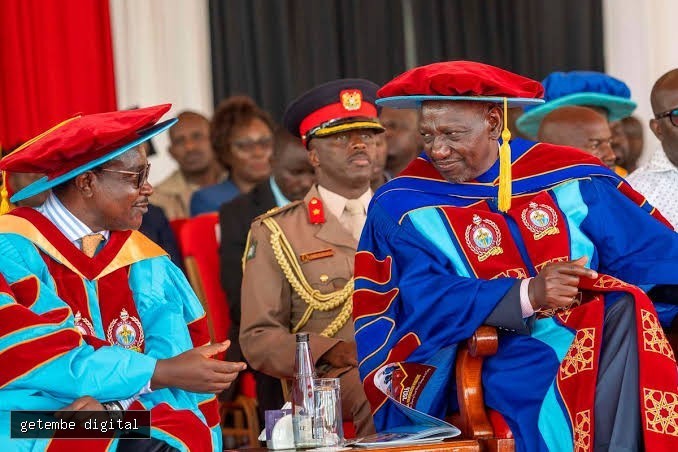
President William Ruto has renewed his promise to overhaul Kenya's higher education funding system, announcing that university, TVET and Kenya Medical Training College (KMTC) students could receive full financial support from January 2027.
The announcement, made on Wednesday, November 11, during the commissioning of the Ibeno KMTC campus in Nyaribari Chache, Kisii County, comes as public universities struggle with mounting financial obligations exceeding KSh100 billion.

Ruto said his administration was pursuing amendments to the Higher Education Loans Board (HELB) Act and consolidating existing legislation to establish a unified framework for student placement and financing.
Addressing students at the institution, the President said the government wanted to move beyond simply placing learners in universities and colleges to ensuring they received the financial assistance required to complete their education.
"We will not only be placing students, but we will also fund them," Ruto said.
He added that education should not depend on the financial circumstances of a student's parents but on the learner's academic ability.
The proposed changes are expected to extend financial assistance to students in universities, technical and vocational education and training institutions, and medical training colleges.
However, the President's latest promise raises a significant question: Can the government expand financial support for students while the institutions expected to educate them are struggling to meet their existing financial obligations?
The financial situation facing Kenya's public universities has continued to attract parliamentary scrutiny.
According to disclosures by the State Department for Higher Education, public universities had accumulated pending bills amounting to KSh100.3 billion as of January 31, 2026.
The liabilities had increased from KSh85 billion recorded in July 2025, representing a 17.6 per cent rise in eight months.
Egerton University accounted for KSh25.5 billion, followed by the University of Nairobi with KSh17 billion, Kenyatta University with KSh12.8 billion and Moi University with KSh10.4 billion.
The obligations include unpaid salaries and wages, statutory deductions, Sacco contributions, suppliers, part-time lecturers and stalled infrastructure projects.
A breakdown of the liabilities shows that KSh33.21 billion involved statutory deductions, KSh26.34 billion unpaid salaries and wages, and KSh18.63 billion unremitted Sacco deductions.
The institutions also owed KSh4.69 billion to part-time lecturers, KSh4.17 billion to suppliers and KSh3.03 billion relating to capital projects.
The figures illustrate the extent to which financial difficulties have spread beyond individual institutions, affecting employees, contractors, suppliers and the delivery of academic services.
In November, university vice-chancellors sought government intervention over KSh33.3 billion in outstanding statutory deductions, including negotiations with the Kenya Revenue Authority over accumulated penalties and interest.
Kenyatta University Vice-Chancellor Professor John Okumu told parliamentary investigators that the institution had entered into payment arrangements with KRA but sometimes defaulted because of inadequate funding.
University of Nairobi Vice-Chancellor Professor Ayub Gitau also disclosed that the institution was exploring arrangements with the Ministry of Education over outstanding PAYE obligations.
The statutory deductions form part of the wider financial obligations reported across universities and should not be added separately to the KSh100.3 billion figure.
The financial problems facing public universities have developed over several years, with changes in student admissions, government funding and institutional revenue streams contributing to the pressure.
For years, universities relied partly on privately sponsored students to supplement government funding.
The privately sponsored student programme generated additional revenue that institutions used to finance infrastructure, recruit staff and meet operational expenses.
However, changes in secondary school examination performance and university admissions reduced the number of students qualifying for these programmes, weakening an important source of institutional income.
The situation was compounded by the Differentiated Unit Cost (DUC) funding model introduced in the 2017/2018 financial year.
The model was intended to finance university programmes according to their actual costs. However, government allocations consistently fell below institutional requirements, leaving universities struggling to meet their expenditure.
The government subsequently introduced the Student-Centred Funding Model in 2023, which allocated scholarships and loans according to students' financial needs.
Although intended to make university education more equitable, the arrangement faced legal challenges, implementation difficulties and concerns over the adequacy of funding.
Ruto's latest proposal represents another attempt to restructure the system.
The proposed reforms are contained in the Tertiary Education Placement and Funding Bill, 2026, National Assembly Bill No. 49 of 2026.
The legislation seeks to establish a more coordinated framework for student placement and financing across Kenya's tertiary education institutions.
It proposes the creation of a Tertiary Education Funding Authority (TEFA), which would consolidate important financing responsibilities currently distributed among existing institutions, including HELB and the Universities Fund.
The objective is to simplify the administration of student support and ensure learners entering universities, TVET institutions and other tertiary colleges have access to financial assistance.
The proposal follows Ruto's July 21 announcement at State House, where he said the government intended to move away from the household-income-based approach towards a universal funding arrangement.
Under the proposed direction, students qualifying for admission would receive government support regardless of their parents' financial backgrounds.
However, there is an important distinction between the President's promise and the actual implementation of the policy.
The proposed Bill is not yet law. The National Assembly's October 23, 2026, Bills Tracker still listed it at the First Reading stage, with the subsequent readings and presidential assent outstanding.
Parliament must therefore complete the legislative process before the proposed framework can become operational.
There are also important questions surrounding the balance between loans, scholarships and grants, the transition of students already receiving assistance and the financial resources required to sustain the arrangement.
Even before the proposed reforms take effect, the government is already facing significant financial pressure in supporting students under the existing system.
Budget estimates for the 2026/2027 financial year show that HELB requires KSh112.1 billion to support approximately 1.38 million university and TVET students.
However, the National Treasury allocated only KSh56.3 billion, leaving a shortfall of KSh55.8 billion.
The Universities Fund also faces a financing gap.
The agency requires approximately KSh47.36 billion for scholarships and institutional support but received an allocation of KSh31.1 billion, leaving another KSh16.26 billion deficit.
Combined, the two agencies face a projected funding shortfall of approximately KSh72.06 billion.
These figures raise questions about how the government intends to finance a universal funding arrangement without worsening existing budgetary pressures.
If the January 2027 commitment is implemented, the Treasury will need to provide a clear financing framework showing how much will be allocated, how funds will reach institutions and whether the allocations will cover the full cost of students' education.
The government must also clarify how the proposed system will address students' upkeep, accommodation and other academic expenses.
While Ruto's announcement could improve access to higher education, the proposed reforms do not automatically resolve the financial problems facing public universities.
There is a fundamental difference between financing students and financing the institutions responsible for educating them.
Student funding covers expenses associated with accessing education, including tuition and other approved academic costs.
Universities, on the other hand, must finance salaries, infrastructure, research, utilities, equipment, maintenance and outstanding obligations to suppliers and contractors.
A university may receive additional student-related funding and still struggle to pay its employees or settle historical debts if institutional financing remains inadequate.
This is particularly important considering that public universities have accumulated KSh100.3 billion in pending bills, including unpaid salaries and statutory deductions.
The State Department has also acknowledged that these pending bills were not provided for in the approved 2026/2027 budget ceilings.
Consequently, even if Parliament approves the proposed funding reforms and the government implements them in January, a separate financial intervention may still be necessary to address historical liabilities.
Such an intervention could involve independently verifying university debts, restructuring outstanding obligations, negotiating statutory debt settlements and providing targeted support to financially distressed institutions.
At the same time, university administrations must account for how they utilise public allocations, improve revenue collection and strengthen expenditure controls.
The Auditor-General and Parliament will also have an important role in ensuring that additional funding translates into improved institutional financial health.
Ruto's proposed higher education reforms come at a time when Kenya is attempting to expand access to university and technical education while struggling to finance the institutions delivering those services.
The President wants financial circumstances to stop determining which students can access higher education. However, the institutions expected to implement that ambition are already facing significant financial difficulties.
The proposed legislation could provide a new direction for student financing, but its success will depend on the availability of resources, timely disbursements and the ability of the government to meet its commitments.
More importantly, Kenyans need clarity on whether the January 2027 reforms will address only the cost of educating future students or also provide a credible solution to the financial crisis inherited by existing public universities.
The KSh100.3 billion pending bills cannot disappear simply because a new funding authority is established.
For universities such as Egerton, Nairobi, Kenyatta and Moi, the immediate concern remains how to meet existing obligations while continuing to provide education.
Ultimately, Kenya needs a funding framework that does two things simultaneously: ensures students can afford higher education and gives universities the financial capacity to deliver it.
Without addressing both sides of the problem, the country could end up financing access to institutions that are themselves struggling to remain financially sustainable.
ADVERTISEMENT
Watch Getembe TV Live
Broadcast Getembe TV Live Stream
Listen Getembe FM Live
Tune in to Getembe FM Live Broadcast
How do you feel about this article?
Let us know by choosing a reaction below.

Written by FRANKLINE NYANDORO
Reporter and staff writer at Getembe News.
Comments 0
Please log in to participate in the comments section.
No comments yet. Be the first to share your thoughts!
ADVERTISEMENT
Related Stories

Have a news tip?
Do you have an investigation, local story or news event you think we should cover? Contact our newsroom directly.
Submit Tip
Mobile App
Download Getembe Digital App Today
Download Getembe Digital App today for live news updates, breaking notifications, and seamless live streaming.